Guidance: The role of a senior independent director
This resource sets out to support senior independent directors (SIDs) to navigate key aspects of their role, including requirements, responsibilities, and common challenges that may arise.
The role of a SID
The senior independent director (SID) plays a pivotal part in supporting effective unitary board governance, strengthening relationships, and providing an additional route for challenge and assurance.
The role and duties of a SID in the NHS are identified within the code of governance for NHS provider trusts. There are a range of other key documents that set out the duties and guidance, we will explore these in this guide.
The key duties are to:
- support the chair by acting as a sounding board
- liaise with the directors
- carry out the annual appraisal of the chair
- liaise with governors in foundation trusts
- provide access to conflict resolution and mediation
- enable effective governance and resolution in times of crisis or tension.
It is important that the SID takes time to understand the role and prepare for the challenges that it presents. They’ll need to:
- Remain independent, dispassionate and focused.
- Understand how and where to obtain governance, people and, where appropriate, legal advice.
- Network with directors and governors to maintain a knowledge of the soft intelligence and what impact individuals, behaviours and the application of effective governance have on the trust.
In this guide we set out:
- The origins and evolution of the SID in the NHS.
- The regulation and guidance requiring the role in trusts and integrated care boards.
- The arrangements for the appointment of the SID and the role description.
- The duties, experience and qualities of the SID.
- The framework for conducting annual appraisals of an NHS trust / foundation trust chair.
- The NHS leadership competency framework.
- Guidance relating to governors.
- The effect of the 10-year health plan for England on the future duties of the SID.
- Scenarios that may require SID intervention.
- Sources of support, advice and contacts.
What are the origins of the senior independent director in the UK?
The Higgs review into the role of non-executive directors in the corporate sector (2003) recommended that boards of publicly listed companies should appoint a SID from among their independent non-executives. SIDs were added to the revised “Combined Code” in 2003 and today remain in the UK Corporate Governance Code (2024).
In the private sector the duties would normally involve:
- Working closely with the chair, acting as a sounding board and providing support.
- Acting as an intermediary for other directors as and when necessary.
- Being available to shareholders and other non-executives to address any concerns or issues they feel have not been adequately dealt with through the usual channels of communication (i.e. through the chair, the chief executive or finance director).
- Meeting at least annually with the non-executives to review the chair’s performance and carrying out succession planning for the chair’s role.
- Attending sufficient meetings with major shareholders to obtain a balanced understanding of their issues and concerns.
Source: What is the role of the senior independent director? | Factsheets | IoD
These same principles have been carried through into NHS governance and are for the most part reflected in the code of governance for NHS provider trusts.
What does the Code of governance for NHS provider trusts say about the SID?
The code* is applicable to all NHS providers; it contains multiple references to the role and duties of the SID and each of these references has been listed below:
- The board should identify a deputy or vice chair who could be the SID. The chair should not sit on the audit committee. The chair of the audit committee, ideally, should not be the deputy or vice chair or SID.
- In consultation with the council of governors, NHS foundation trust boards should appoint one of the independent non-executive directors to be the SID: to provide a sounding board for the chair and serve as an intermediary for the other directors when necessary.
- Led by the SID, the foundation trust non-executive directors should meet without the chair present at least annually to appraise the chair’s performance, and on other occasions as necessary, and seek input from other key stakeholders. For NHS trusts, the process is the same but the appraisal is overseen by NHS England as set out in the Board member appraisal guidance.
- The responsibilities of the chair, chief executive, SID if applicable, board and committees should be clear, set out in writing, agreed by the board of directors and publicly available.
- There should be a formal and rigorous annual evaluation of the performance of the board of directors, its committees, the chair and individual directors. For NHS foundation trusts, the council of governors should take the lead on agreeing a process for the evaluation of the chair and non-executive directors. The governors should bear in mind that it may be desirable to use the SID to lead the evaluation of the chair. NHS England leads the evaluation of the chair and non-executive directors of NHS trusts.
Appendix B: Council of governors
…. The council of governors should input to the board’s appointment of a SID.
The council of governors should only exercise its power to remove the chair or any non-executive directors after exhausting all means of engagement with the board of directors. The council should raise any issues with the chair with the SID in the first instance.
The chair (and the SID and other directors as appropriate) should maintain regular contact with the governors to understand their issues and concerns.
…. The SID should attend sufficient meetings with governors to hear their views and develop a balanced understanding of their issues and concerns.
Applicability for integrated care boards
The role of SIDs has been introduced into integrated care boards (ICBs) by NHS England guidance set out below:
Guidance on integrated care board constitutions and governance (July 2024)
In line with the governance requirements of NHS trusts and foundation trusts regarding SIDs, ICBs should make one of their non-executive board members the senior non-executive member to support the NHS England regional director in the appraisal of the chair and their compliance with the fit and proper person test, and to act as a sounding board for the chair and – if necessary – to mediate between the chair and other board members.
- The senior non-executive member may, unless they are the audit committee chair, be the deputy chair.
- While the notes to the previous version of the model constitution stated that appointing a senior non-executive member was good practice, it is now expected that all ICBs ensure that one is in place.
NHS England » Guidance on integrated care board constitutions and governance
What are the arrangements for the appointment of the senior independent director in a trust?
The duties and responsibilities are set out in the code of governance*.
The process should be set out within the trust's constitution (for NHS foundation trusts) and/or the trust’s standing orders. The process should be open and transparent enabling all non-executive directors to be considered.
The appointment is made by the board of directors. In foundation trusts, this must be in consultation with the council of governors.
Trusts can choose to use the remuneration structure for NHS provider chairs and non-executive directors to award a supplement of £2,000 p.a. to the SID. ** The 2019 guidance may be reviewed soon. The number of supplements that can be made are limited to either two or three roles, based on the size of the trust.
The insightful provider board (2024) recommends provider boards consider: “Are the roles and responsibilities of the SID clear and agreed by the board?” *** This can be achieved via a combination of a role description, the trust’s scheme of reservation and delegation, the trust constitution (for a foundation trust) and/or the standing orders for the board of directors. A SID should familiarise themselves with the references to the role within all their trust’s governance documentation.
*NHS England » Code of governance for NHS provider trusts
Is a role description required?
A trust should have a role description for their SID to bring together the requirements set out in the code of governance and other key guidance documents.
This enables the trust and the SID to have clear expectations of the role responsibilities, and to also support compliance with the expectation of clarity and agreement on the role, as stated in NHS England’s Insightful Provider Board (2024)*.
*NHS England » The insightful provider board
Examples of senior independent director role descriptions:
Many role descriptions are based on text taken directly from the code of governance for NHS provider trusts. A range of examples are listed in the links below:
- Leeds and York Partnership NHS Foundation Trust
- Sheffield Health and Social Care NHS Foundation Trust
- Bradford Teaching Hospitals NHS Foundation Trust
- Yorkshire Ambulance Service NHS Trust
- Torbay and South Devon NHS Foundation Trust
- Royal United Hospitals Bath NHS Foundation Trust
What duties and responsibilities should be set out in the role description?
The list below sets out a range of “good practice” clauses seen in a range of role descriptions that have been published by trusts on their websites:
- Carry out the annual appraisal of the chair and make a report to the appointments and remuneration committee and the council of governors on the outcome (for foundation trusts only).
- Ensure the chair’s annual fit and proper persons test declaration is processed and submitted to NHS England.
- Be available to directors if they have concerns about the performance of the board or the welfare of the trust, where contact through the normal channels of the chair, the chief executive, or the trust secretary has failed to resolve, or for which such contact is inappropriate.
- Be available to governors and members if they have concerns about the performance of the board of directors, the trust’s compliance with the terms of its licence or the welfare of the trust; where contact through the normal channels of the chair, the chief executive, or the trust secretary, has failed to resolve or for which such contact is inappropriate.
- Help resolve any disagreements that may arise between the council of governors and board of directors, in accordance with any procedures agreed by the trust and set out in the constitution.
- Maintain sufficient dialogue with governors (including regularly attending council of governors’ meetings) to develop a balanced understanding of their issues and concerns.
- When appropriate ensure that the issues and concerns of members and governors are communicated to the other non-executive directors and, as necessary, the board as a whole.
- Meet with the non-executive directors, in the absence of the chair, at least annually to discuss the chair’s performance as part of the annual appraisal process (or for any other reason which may require the non-executive directors to meet without the chair). Chair the nominations committee and the appointments and remuneration committee when matters concerning the incumbent chair are being considered.
- Support the chair in leading the board of directors, acting as a sounding board and source of advice for the chair.
What are the key working relationships?
In addition to the normal board relationships of a non-executive director, the SID will have specific roles and duties that will require stronger or additional relationships.
The following list is an example of the key relationships required:
- The chair of the trust.
- The directors (including other non-executive directors).
- The board of directors.
- The appointment and terms of service committee.
- The nomination and remuneration committee.
- The trust secretary (or the director holding that responsibility).
- NHS England and other regulators in specific circumstances where normal lines of communication cannot be used. The SID may also require legal or HR support in certain circumstances too.
In foundation trusts this will also include:
- the council of governors
- individual governors
- the lead governor
- members.
What experience and qualities are required?
When appointing a SID, the board of directors and the council of governor in a foundation trust will want to consider the experience and qualities required from the person in that role. These are likely to include:
- Be an experienced non-executive, familiar with complex governance.
- Be able to demonstrate diplomacy, discretion, and emotional intelligence.
- Have empathetic listening skills.
- Have strong relationship-building and communication skills.
- Be seen as independent, fair, and trustworthy by both executives and non-executives.
- Have analytical and problem-solving skills.
- Have the time to commit to the additional duties.
- Commit to, or have already undertaken, training for the role.
- Be empowered and able to take advice on the specifics of the role.
Conducting annual appraisals of NHS chairs
Many trusts will have in place well established processes for the annual appraisal of their chair. These arrangements will often include comprehensive processes for collecting feedback, and in foundation trusts, the agreement with the council of governors on the process to be adopted.
NHS England guidance, published in April 2025, outlines expectations and recommendations in the completion of board member appraisals, including the chair. It includes template documents to assist in the process. The guidance is not prescriptive and local variation is allowed. Where variation is adopted, the trust should be prepared to explain its rationale for doing so in well-led reviews and in regulatory inspections.
The process for conducting annual appraisals of NHS chairs is described within the guidance, as follows:
- The chair appraisal should be conducted/facilitated by the SID or in the absence of a SID, the deputy chair.
- A copy of the appraisal summary should be sent to the NHS England Senior Appointment and Assessment team at england.chairsappraisal@nhs.net
- For ICBs – the SID should gather evidence and facilitate the appraisal process. Regional directors will meet with the ICB chair to review the appraisal.
- For NHS provider trusts – regional directors may choose to hold a review meeting where concerns are identified, or the organisation is in the National Recovery Support Programme (RSP).
- All chair appraisals will be signed off by the regional director and for ICBs and NHS Trusts, sent to NHS England’s chief operating officer for endorsement.
NHS England » Board member appraisal guidance
The guidance sets out a number of ‘what’ principles, focused on what the appraisal should contain, and ‘how’ principles focused on how it should be undertaken.
The ‘what’ of appraisals is that they:
- Are the culmination of ongoing dialogue, reviews and check-ins over the year.
- Incorporate the six domains of the Leadership Competency Framework and feedback from multiple sources.
- Should look forward to the coming year.
- Set SMART objectives and include an equality, diversity and inclusion-specific objective.
- Take a developmental approach.
- Focus on the interaction between chairs and chief executives in appraisals for those postholders.
The ‘how’ of appraisals:
- ‘A partnership dialogue’.
- All stakeholders involved should conduct themselves in line with the values and behaviours of Our Leadership Way, the NHS People Promise, NHS values, the NHS Constitution, and the seven principles of public life (Nolan principles).
- Objective setting should be driven by the appraisee.
- Assessment should consider both the achievement of objectives and the behaviours and values displayed.
- A developmental review and plan should be agreed.
A briefing on the guidance is available in this link:
The NHS Alliance: Board member appraisal guidance
The guidance is aligned with the NHS Leadership Competency Framework.
The NHS leadership competency framework
The NHS leadership competency framework says that the SID (or deputy chair) should carry out the appraisal for the chair based on the framework and other objectives, and ensure the findings feed into the personal development plan of the chair. Template documents are available to assist in this assessment.
The framework is illustrated below:
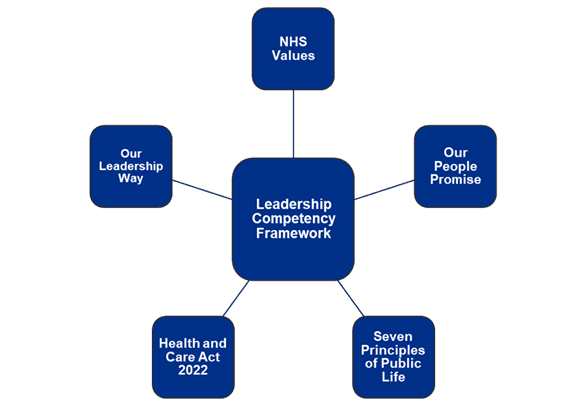
NHS leadership competency domains
The domains against which chairs should be assessed are:
- driving high-quality and sustainable outcomes
- setting strategy and delivering long-term transformation
- promoting equality and inclusion, and reducing health and workforce inequalities
- providing robust governance and assurance
- creating a compassionate, just and positive culture
- building trusted relationships with partners and communities.
NHS England » NHS leadership competency framework for board members
What are the duties relating to the fit and proper persons test?
The NHS England: Fit and proper person test (FPPT) framework for board members (April 2025)* requires:
- “Annually, the SID or deputy chair will review and ensure that the chair is meeting the requirements of the FPPT.
- If the SID and deputy chair are the same individual, another non-executive director should be nominated to review the chair’s FPPT on a rotational basis.”
- The SID may also be required to sign off the Board Member Reference for the Chair at the end of their tenure.
The framework includes guidance and template documents for completion. Trust’s will have a lead officer for the return of the FPPT submissions. The SID should work closely with that officer to ensure timely and accurate submission of the chair’s return.
*NHS England » NHS England Fit and Proper Person Test Framework for board members
The SID’s work with governors
The code of governance for NHS provider trusts (appendix B) sets out specific duties in relation to governors.
There are some specific references to the role of the SID contained in: Your statutory duties: A reference guide for NHS foundation trust governors* (2013). This is the core document setting out governors’ role and duties and will help SIDs to better understand a council’s functions.
The specific roles set out are:
- Provision of information by directors to governors – “If the governors are not satisfied with the chair’s response, they may also consider speaking to the senior independent director...”
- Annual performance appraisal for the chair – “The senior independent director would be expected to lead the actual appraisal (although one or more governors may also play a significant role)...”
- Appointment and first year objective setting for the chair - should be done by the council of governors with advice from the SID.
- Removing the chair and other non-executive directors – where they are not the subject of the process the SID should be consulted before commencing any removal process.
*Governors_guide_August_2013_UPDATED_NOV_13.pd
What is the impact of the 10-year health plan on the senior independent director’s duties?
Fit for the future: 10-year health plan for England* says:
“We will remove the requirement for foundation trusts to have governors. While governors have provided helpful advice and oversight for some foundation trusts, we expect the next generation of NHS foundation trusts to put in place more dynamic arrangements to take account of patient, staff and stakeholder insight. ...”
At the time of writing this guidance (February 2026): It is believed that the legislation could be passed in the next year to enact changes to the roles and duties of governors in April 2027. There are no proposals at present to replace the council of governors with any statutory mechanism. The role of the SID in foundation trusts is likely to revert to the role as it is carried out in NHS trusts.
Scenarios that may require SID intervention
During periods of stress for the Board, the role of the SID is to work with other directors, and governors when appropriate, to resolve problems to return the Board to a steady state of normality. Whilst not an exhaustive list, some examples of scenarios in which intervention by the SID may be appropriate include the following:
- There is a dispute between the chair and the chief executive.
- Other directors have expressed serious concerns that are not being addressed by either the chair or the chief executive.
- Strategies, plans, and policies being pursued by the chair and chief executive are not supported by the rest of the Board.
- There is an inappropriately close relationship between the chair and the chief executive.
- Decisions outside of the scheme of reservation and delegation are being taken by the chair and chief executive without the required approval of the Board.
- Board development and succession planning are being ignored.
- The council of governors raise concerns about the performance of the chair.
- The chair asks the SID to intervene in conflict with governors.
- NHS England contacts the lead governor and/or the SID regarding matters in which the chair has a conflict of interest.
- The chair seeks support or a second opinion in relation to their duties.
Where can a SID obtain support and advice?
Training for the role
The role of the SID relies on a set of individual qualities and a sound knowledge of the role. Non-executive directors who are selected to take on the role will already have the required qualities, but few will have a comprehensive knowledge of the duties and resources available.
The NHS Alliance delivers a specific course on ‘The role of the senior independent director’, as well as a range of other board development courses that a SID would find helpful in navigating their role. Find out more here.
Additional training in conflict resolution, problem solving and interpersonal communication may also be beneficial to the SID and are often available within a trust’s in-house training offer.
Internal sources of advice
The trust will have a range of sources for advice and support, including:
- The trust secretary or director with responsibility for governance.
- The people and culture (HR or personnel) function.
- Trust in-house or contracted mediation and/or conflict resolution services.
- The trust in-house or contracted legal team.
External sources of advice
The NHS England regional team or Senior Appointments and Assessment Team should be contacted where there are concerns relating to FPPT or appointment terms.
There is a dedicated NHS Futures page for SIDs which is currently under development, within the non-executive workspace, which contains supportive materials designed by fellow SIDs. It also provides the opportunity to connect with SID colleagues or find a potential mentor or buddy.
Contact information for the regional office teams:
This guide was published by The NHS Alliance and commissioned by NHS England in April 2026.