How does Wales’ planning system impact on the health and wellbeing of the population?
Developed with Public Health Wales, this explainer examines how planning decisions affect health and wellbeing in Wales and sets out practical recommendations for creating healthier, more sustainable and resilient communities.

"Access to healthcare is only a small part of what enables people to remain healthy throughout their lives. The built and natural environment (buildings, homes, places, streets, routes, land, watercourses, natural habitats) and the activities undertaken in these (living, working, learning, playing, shopping, travelling, moving) determines the health and wellbeing of the population"
Introduction
How we plan housing, transport, services, green spaces and food environments shapes our daily routines, influencing physical activity, obesity, mental health and wider conditions such as respiratory illness. The Welsh planning system should therefore consider how decisions can have a positive (or negative) impact on our health and wellbeing.
This explainer, developed in collaboration with Public Health Wales NHS Trust, provides an overview of how planning impacts health. It brings together the evidence on the impact the built and natural environment has, from physical activity and obesity to climate resilience, food environments and inequalities. It sets out clear and practical recommendations for how planning policy and practice in Wales can be strengthened to create healthier, more sustainable and future proof places for current and future generations.
How is planning and health and wellbeing linked?
The built and natural environment are key determinants of health and wellbeing. Healthy urban planning is about planning for people, considering the implications of planning decisions on health and wellbeing, and putting the needs of the local population at the heart of decisions.
The way we plan a new development, how housing and travel routes are designed and configured and how accessible local services are, will all influence our life, our work and travel patterns, our access to healthy food and the opportunities we have to be active in our daily lives. These factors in turn link to our mental and physical health and wellbeing outcomes.
Modern town planning in the UK originated from the need to deal with public health concerns, including pollution, sanitation and overcrowding. The quality of the built and natural environment is fundamental to our health and wellbeing, and yet the planning system in the UK is often criticised for not maximising the opportunity to create healthy places through good design in favour of building as many houses as possible.
In recent years, housing and other developments have often been designed around car use rather than people, with limited social and community facilities and a lack of basic amenities including green spaces and opportunities for children to play. The way the environment has been planned and built throughout the 20th and 21st centuries has contributed to a rise in non-communicable diseases such as respiratory conditions, dementia and some cancers.
Why does planning our environment well matter, and how does it affect our health and wellbeing?
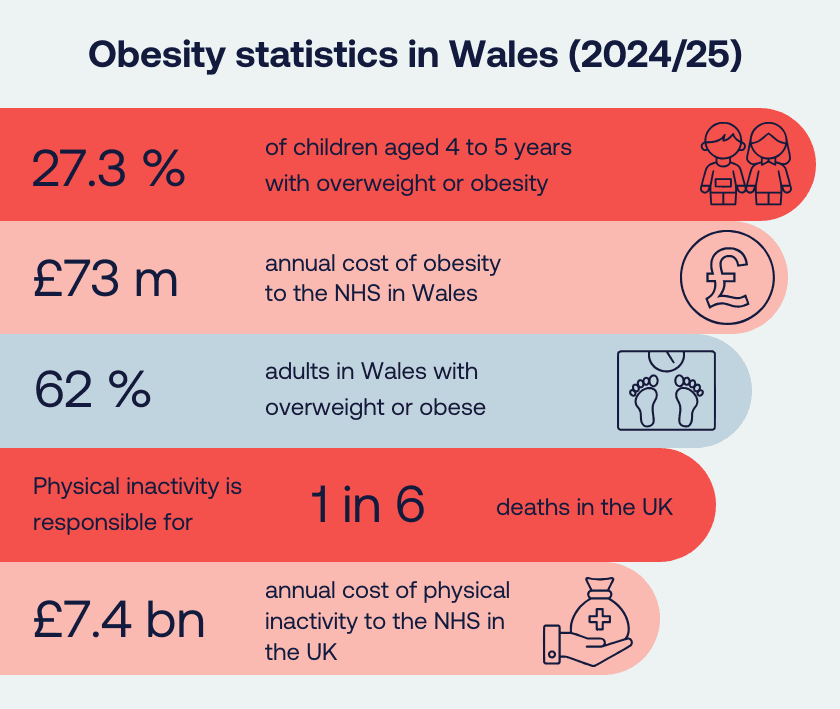
In 2024/2025, the prevalence of children aged 4 to 5 years with overweight or obesity in Wales was 27.3%. The prevalence of children with overweight or obesity varies across local authorities in Wales, with the highest in Isle of Anglesey (31.5%) and the lowest in Vale of Glamorgan (22.4%). In 2024/2025, 62% of adults in Wales were overweight or obese (self-reported data) and 36% were a healthy weight.
Obesity is linked to numerous health conditions such as heart disease, liver disease, diabetes, stroke and fatty liver disease and costs the NHS in Wales around £73 million every year. Physical inactivity is responsible for one in six UK deaths and is estimated to cost the UK £7.4 billion annually.
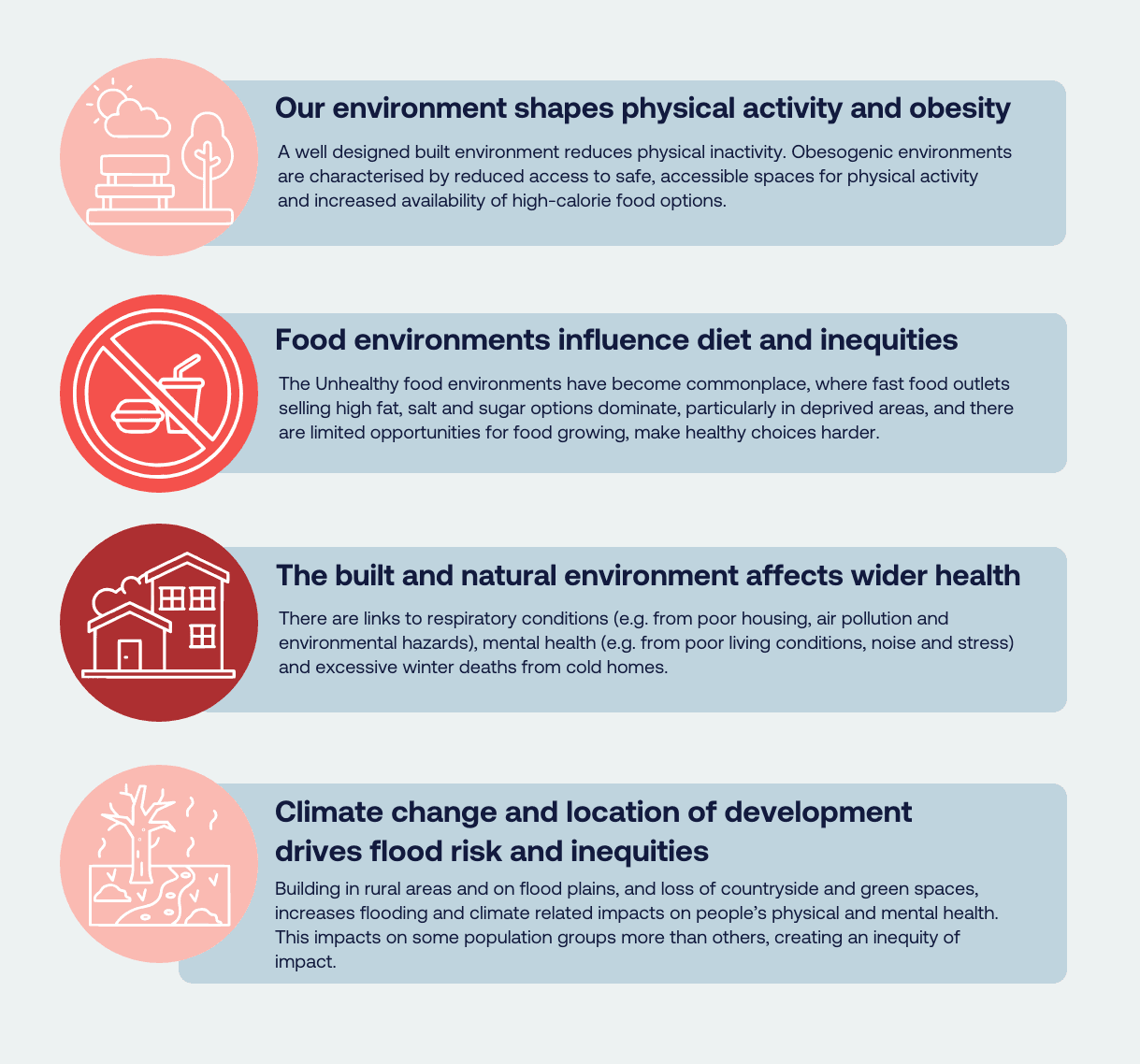
Where we live has a significant impact on our health and wellbeing:
What can be done within the current planning system to improve population health?
The planning system in Wales has a range of powers that can affect change at a local level.
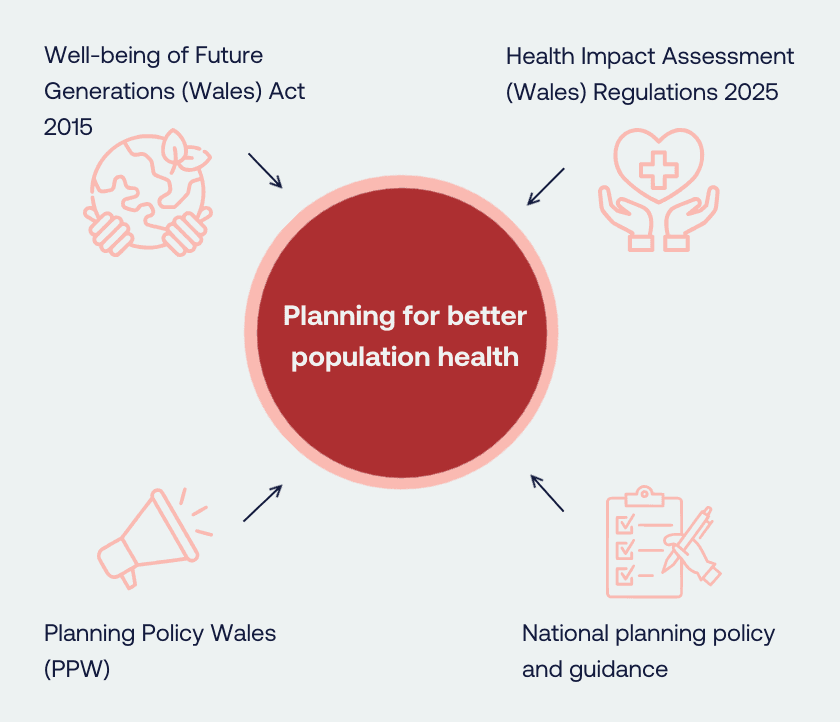
Planning Policy Wales (PPW) sets out the national land use planning policies of the Welsh Government. PPW encourages local authorities to consider how they can use the system to improve health and wellbeing, contribute positively to the Well-being of Future Generations Act, and embrace placemaking.
The Health Impact Assessment (Wales) Regulations 2025 will come into force in April 2027, requiring public bodies to carry out an HIA when it proposes to make a decision of a strategic nature.
National planning policy and guidance provide the framework for the preparation of local development plans (LDPs) by local authorities in Wales, which then inform planning decisions. Supplementary planning guidance (SPGs) support LDPs with details around policy. Many local authorities in Wales have LDP policies and SPGs which are directly or indirectly aimed to improve health and wellbeing.
How could the planning system do more to ‘design in’ good health?
A healthy environment has numerous positive physical and mental health impacts. Creating healthy environments through planning should involve a comprehensive approach that integrates urban design, public health and community engagement.
National planning policy can be clear about how public health issues should be considered in the local planning process. Local plans guide developers, so they must be robust, evidence based and clear about the planning considerations that must be taken into account when designing new development.
Local plans can include clear direction for developers about the need to factor in health and include specific requirements around providing a health supporting environment, such as walkable neighbourhoods, green spaces, community infrastructure, quality homes, and active travel opportunities. They can also include requirements to mitigate for potentially harmful impacts of development.
The enablement of more physical activity opportunities is fundamental to improving health and wellbeing. Making more journeys by active travel means has substantial health benefits, as well as economic and environmental benefits, and is the easiest way for most people to be more physically active in their everyday lives.
To support children’s health and wellbeing, we must create environments that are conducive to health, and enable children to be active, protect them from harm and enable them to play in safe and accessible locations. National planning policies and guidance should be revised to ensure the building of child friendly environments, including nature filled and informal play spaces close to homes and safe, well-connected streets.
Planning guidance needs to be clear about the need for local plans to take a life-course approach and consider the needs of the local population; considering the needs of future generations, different age groups, people with protected characteristics and socio-economic groups. This includes the needs of our rapidly ageing population.
How to make our communities fit for future generations?
In Wales, the Well-being of Future Generations (Wales) Act 2015 places a duty on public bodies to ensure that decisions made today will benefit future generations. This includes
creating healthy environments for children and young people, in turn benefiting the wider population.
Politicians and policymakers in Wales can contribute to this goal through enabling the planning system to have a clearer and stronger focus on health and wellbeing through robust policy planning processes, and not prioritising housebuilding volume over good design.
How can the government and policymakers support healthy urban planning?
The planning system in Wales has a range of powers that can affect change at a local level.
1. Health Impact Assessments (HIAs):
Encourage HIAs for all major development projects to evaluate their potential health impacts and ensure that health considerations are integrated into planning decisions. From April 2027, HIAs will be required under the Health Impact Assessment (Wales) Regulations 2025 by public bodies when making decisions of a strategic nature.
2. Enable active everyday lifestyles:
Prioritise the development of infrastructure that enables walking and cycling to be practical and safe, and public transportation the easy choice, reducing car dependency. Access to green space and play opportunities must be made easier and more equitable to a range of population groups, removing barriers to everyday physical activity opportunities.
3. Inclusive design:
Implement policy that ensures inclusive design is incorporated into new development, ensuring that everyone can benefit from the natural and built environment. This includes accessible and safe active travel, public transport, dementia and sensory-impaired friendly environments, safe pedestrian crossings, age-friendly accommodation and public spaces (eg inclusion of resting points and public toilets). Consult with local health boards and public health teams at pre-application phase of development so that healthcare service and population health needs can be factored into the design process.
4. Sustainable locations for new development:
Implement policy to ensure new development prioritises development on brownfield sites and locations near to existing neighbourhoods and public transport networks, allowing for walkable neighbourhoods to be created and enhanced. Prioritise the principles of placemaking for all new development and restrict development in areas vulnerable to climate change implications, such as flood risks.
5. Natural spaces and recreation:
Increase the provision of parks, community gardens, play and recreational facilities, and enable access to nature, particularly in areas where there are known to be inequalities in access. Ensure green space is designed with a life-course approach, to meet the needs of the population.
6. Child-friendly environments:
Implement the Ministerial Review of Play recommendations in relation to play:
- Ensure the right to play is sufficiently incorporated into strategic policy instruments and decisions;
- Ensure the principle of play as a matter of spatial justice is recognised and understood throughout Planning Policy Wales;
- Ensure the views and experiences of children inform the ways in which neighbourhoods are planned and managed.
This aligns with the principles of the Well-being of Future Generations Act.
7. Age-friendly environments:
We need to plan neighbourhoods that enable our ageing population to continue to live independently in their own homes for as long as possible. This means places and spaces that enable older people to take physical activity, access services and meet other people:
- Ensure housing is provided to meet needs of older people, both in terms of older people-specific accommodation, but in creating ‘lifetime homes’, and that it protects their health through being able to withstand extremes of temperature due to climate change
- Ensure housing for older people is located in places they can walk, cycle or use public transport to get to services and activities
- Design green spaces and community areas to meet the needs of older people, for example through provision of benches and toilets
- Provide community facilities to provide the opportunity to meet others, reducing the risk of loneliness
- Ensure dementia-friendly spaces are included in new development
8. Healthy food environments:
Implement policies to encourage the establishment of healthy food outlets and food growing opportunities. Implement clear policy guidance in national planning policy to limit the density of hot food takeaway and fast-food outlets. For example, as in the National Planning Policy Framework for England:
Local planning authorities should refuse applications for hot food takeaways and fast-food outlets:
a) within walking distance of schools and other places where children and young people congregate, unless the location is within a designated town centre; or
b) in locations where there is evidence that a concentration of such uses is having an adverse impact on local health, pollution or anti-social-behaviour.
9. Community engagement:
Ensure meaningful engagement with communities in the planning process to ensure developments meet their health needs and preferences. This can be achieved through strengthening the requirement for public consultations and collaborative planning activities such as design review workshops or panels.
Engagement with the community at pre-application stage of planning applications would result in more collaborative design and meeting of population needs.
Summary
The built and natural environment are key determinants of health and wellbeing and can have a significant impact upon an individual’s health and wellbeing. Through the Well-being of Future Generations Act and the introduction of the Health Impact Assessment (Wales) Regulations 2025 we have an opportunity in Wales to enable the planning system to have a clearer focus of creating health environments for future generations.
Public Health Wales NHS Trust have produced a guide for local authorities from that summarises the evidence around the connections between planning and health.
This explainer was developed in conjunction with Liz Green, consultant in public health/programme director for Health Impact Assessment and Cheryl Williams, principal public health practitioner, Wales Health Impact Assessment Support Unit (WHIASU), Public Health Wales NHS Trust.