ICB mergers: lessons for future success
Establish practical and streamlined governance arrangements
Why this matters
The combination of scale, complexity, pace and risk associated with this type of change means governance arrangements must support effective decision-making and assurance. As two or more ICBs come together, these arrangements are a key part of supporting good partnership working.
What works in practice
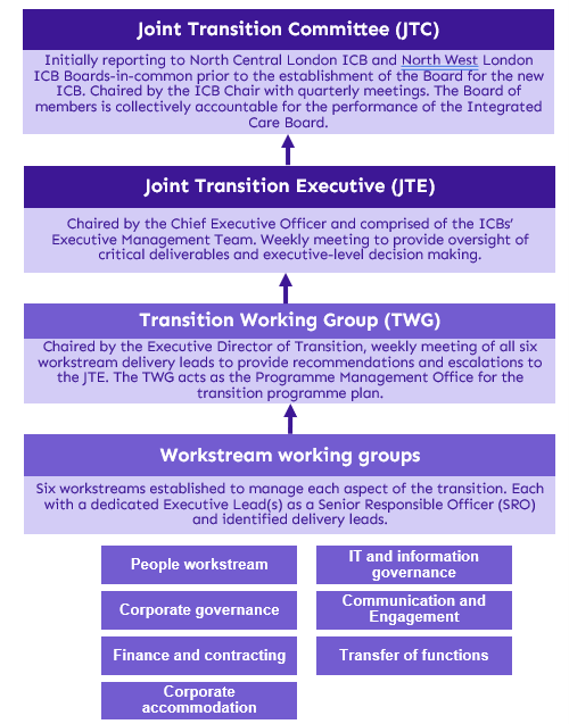
As with other clustering ICBs, transition governance arrangements in the six ICBs were stood up at pace and focused on ensuring simplicity and limiting duplication while providing assurance and managing risk. Each ICB cluster aligned its existing governance arrangements, including setting up boards in common as well as a transition committee to provide oversight of the merger. Transition committees reported into the board in common or separate relevant ICB boards.
ICBs took different approaches to membership of transition committees but aimed to bring together relevant senior leaders from the two or three ICBs in the new geography. Some included NHSE regional colleagues to avoid duplication and strengthen feedback loops with the centre, while others kept membership small for efficiency.
Some ICBs had to establish specific governance arrangements to manage the disaggregation of a legacy ICB and transfer towards multiple other ICBs. For example, in one region a specific joint transfer project group was established which fed into multiple ICBs.
Advice from ICB leaders
- Consider including non-executive directors on the transition committee and update them outside of formal structures, to bring additional scrutiny and challenge to the process.
- Establish task and finish groups for specific areas, such as people and culture, contracts and procurement or finance.
- Good partnership working between colleagues and additional resourcing can help things work effectively.
Work in practice
Transition governance arrangements in West and North London ICB