Children's in-school mental health programme alleviates pressures on services under strain
How a classroom-based mental health education programme is preventing referrals to CAMHS, MHSTs and SENCOs.
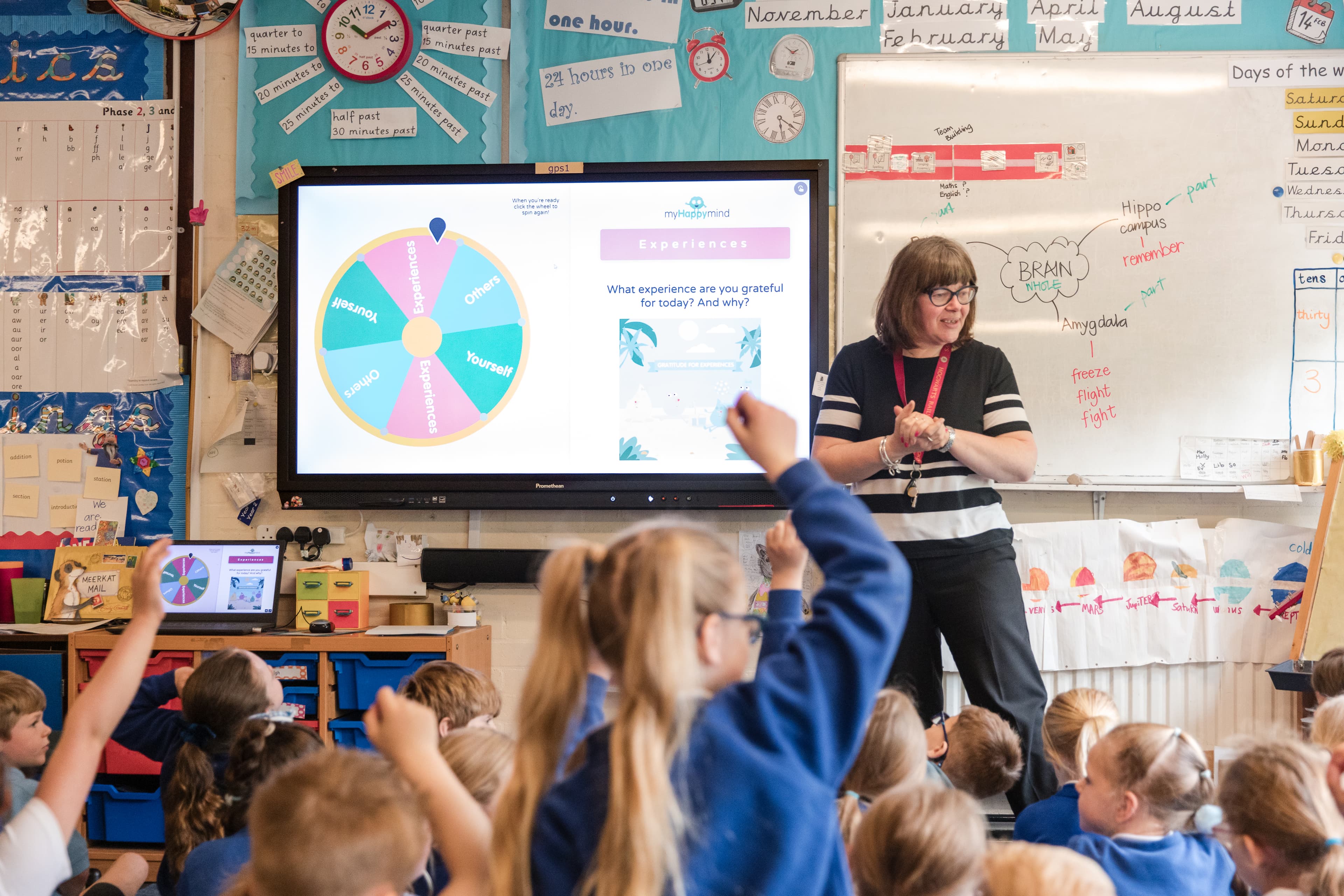
A classroom-based mental health education programme has prevented over 1,500 referrals to under-pressure child and adolescent mental health services and more than 2,500 referrals to mental health support teams – in just one local authority.
Known as myHappymind, the programme has also resulted in a radical scaling back of referrals to special educational needs coordinators (SENCOs) within schools. This has freed up capacity to support more children with the most significant special educational needs.
The NHS is commissioning myHappymind to foster a positive approach to mental health and wellbeing in schools, with the aim of preventing mental health issues before they arise.
The approach aligns closely with the 10 Year Health Plan’s vision to embed preventative, digitally delivered mental health education in the community, and the ambition to expand mental health support teams (MHSTs) to 100 per cent of schools in England by 2029/30.
The programme features content designed for children, which is taught in class by teachers using a digital platform, an app available for parents and carers to further support children at home, and a wellbeing course for staff. myHappymind can deliver the Whole School Approach component of the MHST model.
Schools using myHappymind are seeing fewer children being referred to SENCOs and mental health support teams in schools, as well as fewer needing referrals to stretched child and adolescent mental health services (CAMHS). This highlights the preventative power of the programme, supporting children to avoid escalating need.
“It has provided a whole school approach for the first time and gives the whole school community a joint approach to mental health,” the headteacher of Hepworth Junior and Infant School reflects.
“It feels like we are doing something positive and forward-thinking rather than applying sticking plasters when children are at crisis point.”
Demand for services is outstripping supply nationally, with the latest annual Children’s Commissioner report showing that nearly 50,000 more children with active referrals were still waiting for treatment to begin at the end of March 2024, compared to the previous year.
The programme is being used in over 2,000 schools across more than 40 places across the UK, and has begun to be adopted by schools across Europe, Asia and the Middle East.
Exact return on investment varies between places but the average is in the region of 30x when all these factors are considered. This is because the cost of the programme is significantly lower than the cost of delivering mental health services through the NHS, which myHappymind helps to prevent the need for.
Direct costs for delivering the programme fall to individual schools, or funding is provided by places or systems through which the programme is commissioned.
“The programme provides a curriculum for teachers that’s really engaging and exciting and tailored to kids’ needs, which makes it easy to deliver for staff who often aren’t trained in health services or mental health,” explains Steve Tatham, programme lead (Starting Well, Mental Health and Planned Care) at Cheshire and Merseyside Integrated Care Board.
“It has been really well adopted by schools in Warrington and the feedback has been overwhelmingly positive, which has been great, so we have entered into an arrangement with the schools where we joint fund with them, so it is a partnership between ourselves as an ICB and system with the schools. That has led to a conversation around secondary schools who are equally keen to have something to support their young people, which we are now piloting.”
Laura Earnshaw, the founder of myHappymind, explains that the programme’s philosophy is based on five principles:
- Proactive not reactive – every child in the school accesses the programme
- Stigma reversing – focuses on positive psychology and de-medicalising mental health
- A systemic approach – a programme for the children, teachers and parents
- Equitable access for all - neuro-affirmative and tailored to support children with SEN and SEMH needs
- Fun to learn and easy to teach – a highly scalable digital solution
myHappymind was recently recognised with a King’s Award for Enterprise for its work in innovating to deliver better mental health for children.
Jane Case, assistant director of Mental Health Strategic Commissioning and CYP Programme Manager for Bury at NHS Greater Manchester ICB
“I looked at a range of programmes but the evidence base for myHappymind really stood out to me. My background as a learner mentor in schools also gave me some insight – having to make specific individual interventions and what that involved, which led me to consider the potential benefits of a whole-school approach and what that might look like. From a commissioning perspective, I then moved forward to discuss the programme in more detail with Laura and then went away and found the money.
What has been particularly inspirational has been the feedback from children and young people and their families and the staff. From teachers around how it’s changed the culture and from headteachers about how its reduced the need for external services – how they are able to contain and support more children on their own. As a commissioner it has been very empowering having that evidence to take forward.”
Steve Tatham, Programme Lead (Starting Well, Mental Health and Planned Care) at Cheshire and Merseyside ICB
“We were looking at a range of things we could do to support children and luckily we came across myHappymind through discussions with another colleague in Cheshire and Merseyside ICB who had been working closely with the team and had good things to say about how the programme had been received by schools within their place, particularly around younger children and helping them to understand how their mind works.
“The programme provides a curriculum for teachers that’s really engaging and exciting and tailored to kids’ needs which makes it easy to deliver for staff who often aren’t trained in health services or mental health.”
Class teacher, St Patrick’s Catholic Primary School, Kirklees
“myHappymind has changed the mindset, thinking and understanding of regulation for our children and they are using it at home also. It has been completely transformative and it has been amazing to see children using Happy Breathing independently to calm themselves down, without needing support and intervention input.
myHappymind has provided our children with the understanding of the brain, as to why our brain goes into fight, flight or freeze and this has helped children to understand how and why it is important to regulate.”
Female student, year 6, Malpas Alport Primary School in Cheshire
“Children need to learn about this because when they get scared or stressed and they don’t know what the amygdala does, or don’t know what Happy Breathing is, they don’t know how to control it and don’t know how to cope with it, so they will go to fight, flight or freeze and won’t know what to do.
I would say that every school needs to know about myHappymind and how to deal with your brain, because people’s brains work differently. Sometimes people can get upset easier than others.”
Male student, year 6, Malpas Alport Primary School in Cheshire
“I think you should know how to control it because if something difficult comes around you would know what to do in that kind of situation. So it could almost stop you from doing things you know you shouldn’t, if you were calm at the time, but you feel like doing it at that moment. Instead of that you could do Happy Breathing.”
Examples of impact
The findings outlined form part of a wider and increasingly consistent national evidence base.
Across England, independent evaluations and locality‑level reviews are showing that schools using myHappymind are experiencing stronger attendance, improved behaviour, and reduced pressure on specialist services.
The following sections present five further examples – Hampshire & Isle of Wight, Bury, Portsmouth, and Bradford – each demonstrating how whole‑school wellbeing approaches can help children feel more settled, supported and ready to learn.
Hampshire & Isle of Wight: strengthening early years and primary wellbeing
A detailed review by Centre for Mental Health found that early years settings and primary schools across Hampshire and the Isle of Wight (HIOW) are seeing strong, consistent benefits from delivering myHappymind. Teachers described children as highly motivated and enthusiastic, responding well to interactive elements such as songs, characters, journaling and practical tasks.
Across the programme’s five modules, teachers reported clear and measurable impacts:
- 94% saw improved understanding of the brain and self‑regulation techniques
- 95% observed strengthened awareness of character strengths
- 90% saw increases in children expressing gratitude
- 75%+ reported improved listening skills and relationship understanding
- 85%+ saw greater enthusiasm for goal‑setting and perseverance
Headteachers and SENCOs highlighted wider benefits, including improved school culture, stronger staff understanding of mental health, and positive impacts on attendance and referrals. The programme was particularly valued for its impact on pupils with SEN and SEMH needs.
Data from HIOW presented evidence of a significant impact on referrals, with the programme preventing:
- 5,531 SENCO referrals
- 1,504 CAMHS referrals
- 1,411 Child Protection Online Monitoring System (CPOMS) incidents resolved
It also showed a considerable impact on school attendance, with:
- 8,769 attendance improvements
- 2204 fewer expulsions
Centre for Mental Health concluded that the findings from HIOW show strong consistency with earlier validation studies and demonstrate the value of embedding wellbeing into everyday school life.
Bury: improving attendance and attainment in the most challenged schools
Evidence from Bury adds to the growing picture of the wider benefits associated with myHappymind. Across four years of independent Bury Local Authority attendance data and three years of SATs attainment data, schools delivering the programme improved faster than comparison schools, despite starting with higher levels of persistent absence and lower attainment.
The strongest improvements were seen among schools facing the greatest challenges:
- in schools with high levels of SEN, persistent absence improved at 7.4 times the rate seen in comparison schools
- in the most deprived communities, persistent absence improved at 3.4 times the rate
- in high-SEN schools, this reduction was equivalent to around 24 fewer persistently absent children for every 1,000 pupils
- the proportion of pupils meeting the expected SATs standard improved at 12.5 times the rate of comparison schools, increasing by 6.27% compared with 0.50%
- in the most deprived communities, attainment in myHappymind schools improved by 8.71%, while comparison schools saw a 4.43% decline
The findings suggest that investing in children’s emotional wellbeing is associated not only with better mental health, but with meaningful improvements in attendance and attainment. Importantly, the strongest gains were seen in schools facing higher levels of disadvantage and SEN, indicating the potential for whole-school wellbeing approaches to help narrow inequalities.
Portsmouth: reducing suspensions and improving attendance
An independent study conducted by Portsmouth City Council found that schools using myHappymind were significantly more resilient to national attendance and behaviour pressures than those not using the programme. The evaluation compared two groups of schools over a two‑year period, both facing the same post‑pandemic challenges.
The differences were stark. As the report states, “Schools using myHappymind experienced significantly smaller increases in suspensions… Levels of severe and persistent absence rose far less in myHappymind schools than in schools not using the programme.”
- Suspensions increased by 118% in non‑programme schools
- Suspensions increased by just 20% in myHappymind schools
- Severe persistent absence rose by 66% in non‑programme schools
- Severe persistent absence rose by 33% in myHappymind schools
These findings suggest that consistent wellbeing education helps children stay connected to learning and reduces the likelihood of behaviour escalating to suspension. Portsmouth’s real‑world evaluation reinforces the value of embedding wellbeing into everyday school life, not as an add‑on but as a core part of how schools support children.
Bradford: building consistent wellbeing foundations across diverse communities
The same themes seen nationally are also evident in Bradford, where myHappymind is being delivered across a diverse range of primary schools. In their review, Centre for Mental Health found that children across the city were showing strong enthusiasm for the programme and meaningful improvements in wellbeing.
Teachers consistently reported:
- improved emotional regulation
- increased confidence and kindness
- stronger readiness to learn
- more independent use of wellbeing strategies
- wellbeing conversations becoming more common in classrooms
Across the programme’s modules, teachers reported clear benefits:
- 94% saw improved understanding of the brain and self‑regulation
- 95% observed strengthened awareness of character strengths
- 90% saw increases in gratitude
- 75%+ reported improved listening skills and relationship understanding
- 85%+ saw greater enthusiasm for goal‑setting and perseverance
Headteachers and SENCOs highlighted wider impacts on school culture, staff confidence in supporting mental health, and reductions in referrals. As was the case in HIOW, the programme showed particular value for its ability to benefit pupils with SEN and SEMH needs.
For more information
To learn more, contact Laura Earnshaw, founder and CEO of myHappymind at laura.earnshaw@myHappymind.org.