
Putting money where our mouth is?: Exploring health inequalities funding across systems
Insights from health inequalities leads
Allocation of funding
Interviewees were asked the following questions:
On what theoretical, conceptual or other basis were decisions about the allocation of health inequalities funding made?
- What is the ambition behind them?
- Was a theory of change or conceptual framework used?
- What was the evidence behind the decision?
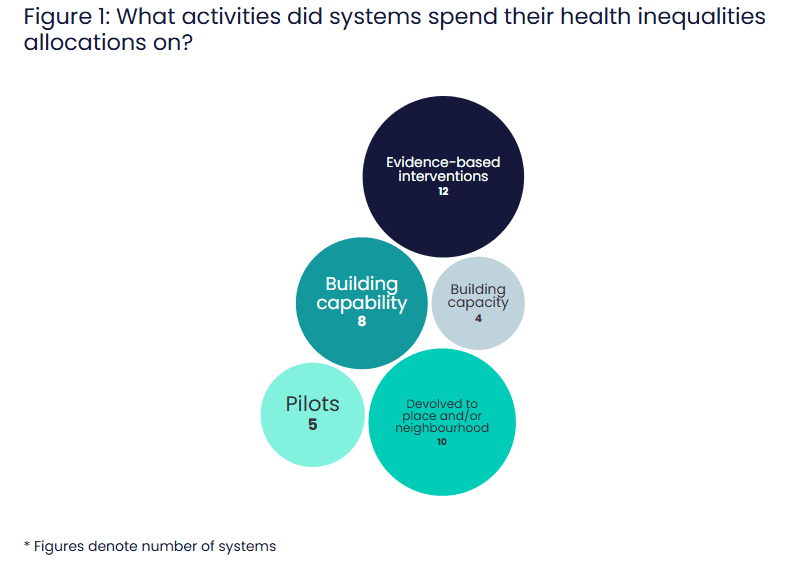
The interviews revealed wide variation in how the share of the £200 million health inequalities funding was used by systems (see figure 1), with some systems setting out principles around how they would use the money:
"We’ve defined a set of principles around what this money is for. It's not for core service delivery, it's for catalytic innovation around quality improvement around certain things." Health inequalities lead, large more rural system
This is not surprising. Guidance to support the development of ICBs’ Joint Forward Plans (JFPs) was produced by NHS England in December 2022 – four months after ICBs were legally established. JFPs are the overarching plans that set out each ICB’s priorities and actions. NHS England’s guidance was released in December with the expectation that inaugural JFPs would be produced by 1 April 2023, outlining ICBs’ plans for 2023/24.
In effect this meant that each new ICB was working without an explicit forward plan for the financial year 2022/23, while undertaking work to create one. As such they were basing decisions on existing data and plans, such as those developed by sustainability and transformation partnerships or clinical commissioning groups and local health and wellbeing boards.
Pilots
A number of interviewees described how they had used some of the health inequalities funding to commission pilot programmes. These tended to be focused on issues faced by specific services or community groups. For some systems, funding pilots resulted in further funding being secured. For example, when pilots generated evaluation data, this was used to present the case for further funding.
Examples of ICB-commissioned pilots using ringfenced health inequalities funding
- Large mixed (urban and rural) system: Improving attendance at general practice diabetes clinics in areas with culturally diverse communities. Piloting approaches that are sensitised to different cultures.
- Large mixed (urban and rural) system: Working with Barnardo’s and the Institute for Health Equity on the mental health and wellbeing of children. Speaking with 300 young people to make sure that their experience informs the work with a focus on emotional wellbeing and self-harm.
- Very large urban system: Allocating funding so that GPs can offer some longer health check appointments, to provide a more in-depth opportunity to explore the issues that are causing people concern about their health.
- Very large urban system: Giving community pharmacies additional funding for families who are below the statutory thresholds access to free prescriptions.
- Large mixed (urban and rural) system: Giving some funding to places to create warm spaces during cold weather. Warm spaces are there for people to keep warm and also act as a hub where attendees can be referred to mental health and cost of living support.
While some systems embraced the opportunity to test novel approaches to targeting funds at specific issues, other interviewees noted that following engagement with local communities, they had decided against trialling pilots.
"So, we're not going to do a six-month project because our community tell us time and time again we need longer-term (projects) and if not, at least something different aligned to our key health inequality areas." Health inequalities lead, large urban system
Building capacity and capability
It is often said that health inequalities is, or ought to be, a golden thread throughout all activities of an ICS. A number of ICBs identified that if health inequalities is to be ‘everyone’s business’, then at this stage of system maturity, attention and investment need to focus on building capacity and capability within the system.
Systems that took this approach focused on building the capacity of the health inequalities team within the ICB, and/or building health inequalities capability (the understanding and skills) of colleagues from across the ICS.
1. Capacity of ICB health inequalities team
Examples of capacity-building activity included investing between 8 and 15 per cent of the ringfenced funding to employ more central staff to monitor and support health inequalities actions across all aspects of the system’s activity, as outlined in their Joint Forward Plan (from 2023/24 onwards), with a particular focus on areas where more development was possible, such as the acute sector, and new areas of responsibility, such as dentistry, pharmacy and optometry.
Other examples included building capacity to improve data management and analysis across the health and care system with regard to health inequalities.
2. Capability in the system
It was clear that there is variation in how health inequalities is interpreted within ICBs. Generally, the Core20PLUS5 framework is considered to be helpful.
For example:
- Is the ICB primarily concerned with health service provision, quality and access with regard to health inequalities?
- Does good practice involve considering how health system activity is integrated with wider prevention activity?
- Are there areas where the ICB has a direct responsibility for prevention?
While strategies for change are system specific, it would be worth considering which actions and strategies are necessary or are the most impactful to action on health inequality in systems. There were different views about where the focus should be: on healthcare inequalities or on health inequalities more generally. While the NHS Core20PLUS5 framework was considered “medical, and that's OK because it is healthcare inequalities and it says what is on the tin”, as one health inequalities lead put it, some ICBs felt that greater attention needed to be given to the social determinants of health and on working with system partners to address health inequalities in a broader sense. Systems that focused on addressing health inequalities in a broader sense tended to devolve the funding to place through initiatives such as warm hubs.
A number of interviewees were concerned that health inequalities could not be a golden thread across the system because the system did not have a shared understanding of health inequalities, in terms of what actions health services could take. To address this, many made a decision to invest in establishing learning networks to build capability and understanding, in effect creating a cadre of experts in different parts of the health and care system. Some of these pre date the ringfenced health inequalities funds, so the investment was used to develop the existing offer.
These expert and peer learning structures included:
- The development (and in some cases development and evaluation) of a system health equity strategy, using funding to collaborate with external experts such as universities, the Institute for Healthcare Improvement, the King’s Fund, ‘deep end’ networks and the Institute of Health Equity. This supports health inequalities leads and relevant colleagues in the ICS to learn from and work with external experts to build their own capability.
- Strengthening the primary care offer through establishing and supporting ‘deep end’ networks to do research into their own impact on health inequalities and lobby for additional support and resources. ‘Deep end’ is a term used to denote the primary care practices that serve ‘areas of blanket deprivation with high proportions of patients living in the 15 per cent most deprived local areas’. This research activity was sometimes linked with local health innovation networks to strengthen evaluation and demonstrate return on investment.
- Establishing a population health academy to support staff to learn about health inequalities and the role of system partners, such as those in the voluntary, community and social enterprise (VCSE) sector. Some academies or learning networks targeted the intake at specific parts of the health and care system such as the VCSE, primary care, nursing staff or managers.
- Establishing leadership development programmes to support the career development of ethnically diverse staff within the system.
Devolving to place and neighbourhood
Many ICBs devolved all or the majority of the health inequalities funding to place, and some ICBs devolved the funding to primary care or neighbourhood level (local authorities, primary care and the VCSE sector). In some systems, dividing the funding between places in the system’s footprint was done according to a formula which sought to take account of deprivation and population size, and in other cases the funding was shared equally across all places.
Once the funding was devolved to place, it was often then devolved further. Approaches to enable access to the funding varied from competitive bidding rounds to allocating funds to specific groups or organisations.
"What we're planning is that the work that we want to focus on - will be very much about that very local community work. It will be informed by the data – deprivation, areas of geography where we know there are people who are more at risk of hypertension, we're looking to work with workplaces and employers that we know employ people that are in lower socioeconomic groups, like the migrant worker population. We're tying it up with our resettlement programme as well." Health inequalities lead, small more rural system
ICBs that devolved the funds varied with regard to the requirements they placed on where the funding should be targeted and how recipients should report back about their use of the funds. Some of the characteristics (these are not mutually exclusive) that describe their approach included:
- Placing no specific requirements except that it should be used to build on existing health inequalities priorities, as set nationally, or by the system or place. For example, some systems indicated that the funding needed to be used in accordance with the Core20PLUS5 approach (national health inequalities priorities).
- Involving directors of public health in the decision-making.
- Targeting the most deprived communities specifically. In some cases this was through the local authority/ies, in others, this was by making funding available to the primary care networks (PCNs) serving the most disadvantaged communities. In others this was through ensuring that ‘Core20’ communities (the most deprived 20 per cent of the national population according to the Index of Multiple Deprivation) received 80 per cent of the funding, with the remaining 20 per cent made available for bids from local stakeholders including PCNs and the VCSE.
- Prioritising funding the VCSE sector.
It was recognised that in some cases this funding was used to cover gaps in existing services for the most vulnerable groups at risk of poor health (for example homelessness) rather than innovation (such as creating new services).
Some felt that one of the significant benefits of devolving the funding to place or neighbourhood level was to build relationships and facilitate partnerships with system partners, in particular local authorities and the VCSE sector. This was seen as particularly important given that ICSs are recent structures that rely on meaningful relationships between all of the organisations that form the system. Using the funding in this way was seen as helping to promote dialogue through establishing critical friend relationships (rather than performance management), bringing the learning and discussion into the ICB.
"The idea was that the money was transformational. It brought people together. It gave you a more holistic view of what the challenge was, made partners work together, broke some barriers down, brought people together." Health inequalities lead; large, more rural system
Devolving health inequalities funding to place was associated with a focus on the social determinants of health, rather than medical or healthcare interventions. For example, an ICB described how it had invested in a warm hub initiative in one of its local authority areas:
"The place stuff, by working with communities and things, gives the opportunity for the NHS to realise its medical model does not work for most of what drives the improvement in health outcomes… It needs to work with others on that wider social model if it's really going to improve health outcomes and create and sustain the ability for the health services to cope with what is coming through the door in terms of health." Health inequalities lead; large, more rural system
Ringfencing
Almost all ICBs used all or some of the health inequalities (HI) allocation for its intended purpose (see figure 2), with half of systems interviewed ringfencing the allocation in its entirety. Seven systems put some of the allocation into health inequalities projects and some into the wider system budget, and three systems put all of the allocation into the wider system budget (this was referred to as the ‘baseline’).
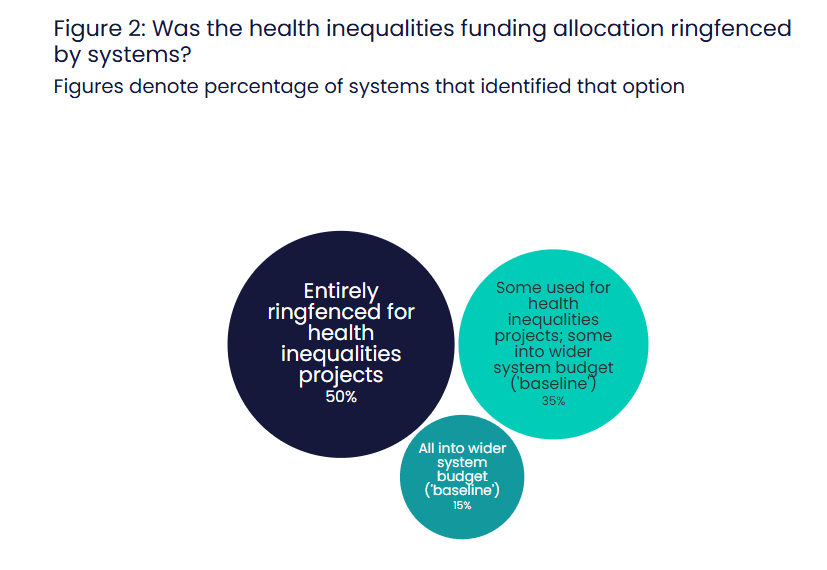
In 2022/23, the health inequalities allocation was a ringfenced funding allocation of £200 million, divided between systems using the health inequalities and unmet need adjustment. From 2023/4, this funding was included in the NHS baseline budget allocations, which means that it will increase in line with inflation but will not be ringfenced in the allocations to systems. In practice, ten ICBs interviewed treated this funding as ringfenced in 2022/23 and have continued to do so in subsequent years, while other systems did not.
"We’ve done quite well at not getting it raided in the way some systems have, I’ll put it that way." Health inequalities lead, large more rural system
"I came in and half (of the ring-fenced funding) was essentially taken into the baseline." Health inequalities lead, large more rural system
While in most cases the health inequalities lead was aware of the funding allocation and actively involved in how it was used, a small number of HI leads were not aware of the allocation, its size or how it was to be used. There were some cases where the HI lead had not been involved in the decision to use the funding to address deficits elsewhere in the system – usually acute or elective hospital care. This may reflect the short time that ICSs have been in existence and/ or the date that some health inequalities posts were established, which may have resulted in limited opportunities to engage in decision-making when the HI funding was first announced. Generally, health inequalities leads noted that this decision was made within the context of ICBs facing significant financial pressures.
Decision-making processes
Interviewees were asked the following questions:
What were the decision-making processes involved in the allocation of the health inequalities funding for 2022-2024?
- What were/are the processes involved in decision-making?
- Who was/is involved?
- How transparent are these processes? How accountable?
- Are decisions made by individuals or boards? What is the role of the ICB/ICS in this process?
- How are the decisions then implemented? What is that process? How transparent is it?
- What did you measure (including impact on health inequalities)?
Evidence and data
Most interviewees talked about the role that evidence had played in decision-making around the allocation of health inequalities funding. These fell into three main categories:
- use of existing population-level data to inform allocation according to need
- drawing on existing evidence of what works to reduce health inequalities and/or improve health for those in the poorest health
- developing new evidence as part of pilot studies or experiments where the allocation of health inequalities funding was either given to new interventions or used to evaluate existing interventions.
1. Use of data to inform decision-making
Interviewees mentioned using existing data to make some commissioning decisions, or work to strengthen and broaden data sets. This included population-level data on health conditions, service use, deprivation and other relevant metrics, which was used to inform decisions about how to allocate health inequalities funding.
"We’re working on a data hub that will provide valuable insights because some of it could be population health level, but some of it we actually need to drill down to primary care data as to who people are and where we will find them. In order to support and improve those outcomes and to be able to reach with interventions and access, health and care service." Health inequalities lead, large more rural system
Some used existing data analysis such as Joint Strategic Needs Assessments to inform the decision-making process, while others developed new datasets and dashboards. These datasets and dashboards were created by putting resource into external partnerships with universities and other organisations. These tools were then used to monitor impact and evaluate effectiveness of the funding. Others used the health inequalities funding to put extra resource into data functions, creating posts for statisticians and data analysts, and training staff and other stakeholders to use these effectively.
"One of the indicators based on household poverty isn't collected nationally anymore. So one of the tasks I've set is ‘can we get some more sort of proxy indicators like; what can we measure a little bit more frequently?’ [To see] if we're on the right lines, on the right way to make a shift in the […] indicators that we've got. So that's how we're going to measure kind of success. But as you know, changing inequalities doesn't happen overnight," Health inequalities lead; very large, more urban system
A few participants mentioned their ICB having used NHS England’s place-based allocation tool to determine how the HI funding was allocated. In some ICBs, data on needs and preferences of the public was also collected as a complementary part of this process, using stakeholder surveys and, less often, community outreach and participation to gather views.
"And then we've also got some data now from [redacted]. So we've got a programme where we're gathering insights from communities into a data bank. […] We're doing that through community connectors, having conversations with people in communities." Health inequalities lead; large, more rural system
2. Drawing on existing evidence of what works
Most ICBs had processes for determining what kinds of interventions might work to reduce health inequalities, although these processes were not uniform and not always transparent to wider stakeholders and the public. Evidence from Prof Sir Michael Marmot’s reports and the Institute of Health Equity was referred to several times by participants whose ICBs had taken into account the social determinants of health as well as healthcare needs, and often was associated with a focus on children and young people and on communities, neighbourhoods and the VCSE sector, as recommended in the Marmot evidence.
Guidance on what works also came from learning networks with other ICBs, primary care organisations and places that had tackled similar issues.
"So I'm I think there's something interesting there about making better use of our places like [redacted place names] – developing a better relationship with [them] and doing a lot more work with them, with primary care, which is really interesting. Particularly trying to invest in the health inequalities fellowships programmes and really trying to think about that like drawing on lots of work the whole system have done." Health inequalities lead; large, more rural system
3. Developing new evidence
New evidence was generated in the form of routine data monitoring or evaluations of new projects supported by the HI funding, either carried out by the ICB or contracted out to external partners. Some ICBs invested in staff training on how to conduct evaluations and monitor impact, and some carried out community outreach.
Evaluation was also carried out on the impact of the funding as a whole for the system, whether this was towards projects and interventions or towards building capacity or strengthening relationships at place or system level.
"We've identified a pot of money as part of the health inequalities fund to support evaluation. But that's evaluation of the fund itself. So how is the fund itself having an impact on health inequalities? Does the process support what we need to in relation to having that impact on health inequalities? How do we have a framework for evaluating going forwards as well as the evaluation of the individual schemes themselves? We hope there's been learning about the process itself. How do we give people enough time to have the conversations that they need to across the system, but then also to build in the co-production element." Health inequalities lead; large mixed (urban and rural) system
Many of those interviewed saw this first year as a pilot stage in terms of their approach to tackling health inequalities, and built in evaluation and monitoring of their activities to inform the system’s future allocation of larger amounts of funding to tackle health inequalities. They were of the view that it was as important to learn about what did not work as much as what did work. This was sometimes referred to as a quality improvement approach.
"Health inequality, it's about testing, learning, experimentation, exploration, learning. There's no failure. It's about what did we learn from that, what we'll do next time and so on, and adaptation and reflection." Health inequalities lead; large, more rural system
Some noted that it was important to be aware of potential challenges associated with evaluation, such as the burden it creates in terms of time and resource spent, or that it might give the wrong answers if it tries to measure long-term outcomes in a short timeframe.
"I think there's a risk there in terms of the evaluation always with these kind of pieces of work, that actually the timescales for the funding are too short have the impact we'd like to see on population health." Health inequalities lead; very large, more urban system
Enablers, barriers and how to overcome challenges
Interviewees were asked the following questions:
What facilitating factors have enabled ICSs to progress action on health inequalities?
- What factors have held ICSs back?
- And how have they overcome these barriers?
The responses can be broadly categorised into leadership, governance, subsidiarity and relationships.
Leadership
The importance of strong and engaged leadership at the top of the organisation was highlighted by many interviewees. One of the challenges identified by many s was how to move the health inequalities agenda into mainstream strategic actions in the ICB. Many interviewees mentioned the importance of leadership at the top of the ICB to achieve this, with key players being the chief executive, deputy chief executive, finance director and chair. This leadership gave health inequalities leads the mandate to raise the profile of actions on health inequalities within the ICB and was linked to longer-term commitments to health inequalities interventions.
In the same vein, a smaller number of interviewees noted that when the finance director was not supportive, this was a barrier to accessing the health inequalities funding.
"There is something fairly powerful about the visibility of inequalities in our system. Our chief executive calls it the ‘north star’ all the time." Health inequalities lead; very large, more rural system
"It's really helpful having the director of finance sitting on the population health transformation board; we've had many conversations." Health inequalities lead; small more rural system
Governance
Many ICBs have created new structures focused on health inequalities as part of the governance of the system and these were generally considered to be a helpful mechanism to raise the agenda of health inequalities with the ICB and ICP leadership.
Committees that were specifically responsible for health inequalities strategy and actions were mentioned often in the interviews. Examples included health inequalities committees, population health and integration committees, health and equalities boards, and prevention, population health management and health inequalities groups. Most had a membership that included representation from the integrated care partnership, for example local authorities, usually the director of public health. In many cases these structures were chaired by a director or a non-executive director (NED) of the ICB, with a reporting line direct to the ICB board.
"The governance within the ICB is that there are committees that have been set up to provide that assurance and health inequalities fits under a health inequalities prevention committee." Health inequalities lead; very large mixed (urban and rural) system
As part of the work to establish ICBs’ new governance structures since their establishment, most have created structures that enable them to develop and take forward system-level actions to address health inequalities specifically.
Addressing health inequalities requires strategic whole-system action, and a number of interviewees noted the importance of cultural change that placed health inequalities more centrally within the governance structures of the ICB. The creation of specific committees and work groups responsible for developing strategic approaches for addressing inequalities, with direct lines of reporting into the board, was a key enabler to action on health inequalities. These structures are important because they are not just concerned with receiving and endorsing reports but provide a place for members to develop a shared analysis, discuss tactical approaches for change and gain support for action.
Relationships within the ICS and with communities
Several interviewees described how they used their influencing and negotiating skills within their networks and with senior officers to influence for change.
"It's a system leadership executive... the director of finance, our chief executive, our place-based leads because that's the highest group... I had numerous one-to-one discussions with everyone to make sure that they were on board. So when it went to the executive group it was really easy: a ten-minute discussion and it's passed. But that's what we mean with the system leadership executive system – leadership!" Health inequalities lead; very large, more urban system
As well as relationship building within the ICB, some interviewees described work to strengthen the voice of people and communities experiencing health inequalities. Examples included:
- Large mixed (urban and rural) system: Working with Barnardo’s and the Institute for Health Equity on the mental health and wellbeing of children. Speaking with 300 young people to make sure that their experience informs the work with a focus on emotional wellbeing and self-harm.
- Very large more urban system: The creation of an inequalities and involvement committee as part of the ICB that aims to bring the voice of marginalised communities into discussion and planning.
"How do we give people enough time to have the conversations they need to across the system, but then also to build in the co-production element?" Health inequalities lead; large mixed (urban and rural) system
The role of the national health and care policy
A number of interviewees highlighted the dissonance between NHS England’s ‘must do’ priorities and local system work on their statutory purpose of tackling health inequalities. They reported feeling that NHS England’s ‘must do’ priorities favour short-term operational issues such as achieving financial balance and reducing waiting times, at the expense of longer-term strategic goals such as tackling health inequalities. It should be noted, however, that these priorities are ultimately decided by targets set by the government.
This is perhaps due to the broader political context. While national policies seem to be moving in the direction of giving more weight to locally set priorities (as confirmed in the government’s response to the Hewitt review), in practice NHS England’s oversight of systems remains focused on the short-term and acute issues. Each year, the government sets a mandate to NHS England which sets out key objectives for the service to deliver that year. In line with the recommendations of the Hewitt review, the mandate set in 2023 contained a reduced number of nationally-set targets, with the intention of allowing local systems the freedom and flexibility to deliver their statutory purposes (including tackling inequalities) according to the local context. There was also a positive move in the planning guidance signalling the importance of inequalities work.
Despite this, in practice, the pressure on NHS England to report on performance and operational improvement from the government exchanges between the centre and ICS leaders remain overwhelmingly focused on short-term priorities. One example of this is a letter sent to systems in November 2023 by NHS England’s chief financial officer, interim chief operating officer, national medical director and chief nursing officer, asking systems to complete a ‘rapid two-week exercise’ to outline their plan to achieve financial balance by the end of the financial year. This led to some ICBs reporting that they felt it was a fight to keep health inequalities as a priority against the focus given by NHS England on short-term operational issues.
These short-term issues, particularly when enforced through rapid ‘must do’ letters, were felt to cut across and unbalance the ICB work to address health inequalities. Several interviewees stated that work on addressing health inequalities is complex and long term, and this does not fit with government, and by extension NHS England’s, requirements to make short-term financial decisions to balance budgets before year end.
Embedding addressing inequalities as a golden thread in everything the system does would mean moving away from seeing these priorities in siloes and instead tackling waiting times (for example), through the lens of inequalities.
"I think the challenge we have is how do you ensure that it doesn’t get diluted or it doesn’t get overridden by the here and now issues which the NHS is very good at, that command and control. ‘Can you tell me how many ambulances are waiting outside the hospital? How many people are waiting for hip operations?’ So it’s trying to break into that and say absolutely we need to do that, but while we’re doing that, let’s be mindful that the people who are more likely to not access services, more likely to receive poor care, are people from the deprived, disadvantaged communities." Health inequalities lead; very large mixed (urban and rural) system
While the dominant narrative in NHS England is focused on short-term operational issues including service performance and financial balance, interviewees recognised and appreciated the work of the NHS England National Healthcare Inequalities Improvement Programme, and particularly the Core20PLUS5 approach. It was widely recognised by ICBs that the health inequalities fund from NHS England was a useful lever that helped to “mobilise conversations around health inequalities” (health inequalities lead, large mixed [urban and rural] system).
However, there was concern that other NHS England initiatives needed to go further to embed health inequalities.
"Can we make sure that the health inequalities agenda is actually embedded within the NHS IMPACT approach? Otherwise again, we'll lose all this great learning that we've got. We're stuck in ‘pilot-itis’ is how I call it. We have great examples but they never become mainstreamed." Health inequalities lead; large more urban system
NHS IMPACT (Improving Patient Care Together) was launched in April 2023 as a national initiative intended to be a ‘single, shared NHS improvement approach’. This interviewee identifies the opportunity presented here to mainstream action on health inequalities through ensuring that it is embedded in central policies. Currently, the approach outlined by NHS IMPACT does not explicitly mention health inequalities.